
How to Search St. Clair County Traffic Court Records
Traffic citations are filed with the 72nd District Court. The county does not keep these files at the County Clerk. Instead, district cases are searched through the county Court Schedules and Records page, which links out to District Case Records. That path connects to the statewide MiCOURT Case Search, the tool Michigan uses for district and probate records where a court takes part.
Gather a few details first. The citation number is the fastest key, since it points straight to one ticket. If you do not have it, the driver's full name works, and a date of birth can narrow a common name. Have the court branch in mind too, because the county runs two district locations.
- Open the county Court Schedules and Records page and choose District Case Records, or go straight to MiCOURT Case Search.
- Select the 72nd District Court for St. Clair County so the query targets the right court.
- Enter the citation or case number if you have it, or search by the driver's name.
- Add a date of birth to trim a broad name result, then run the search.
- Open the matching case to review the charge, hearings, disposition, and any balance due.
Which Courts Handle Traffic Cases in St. Clair County
Every traffic ticket in the county belongs to the 72nd District Court. This is the lower trial court, sometimes called the "People's Court." It hears traffic violations, misdemeanors, ordinance violations, landlord and tenant matters, small claims, and civil cases under $25,000. Felony driving cases are the exception, and those bind over to the Circuit Court after early district stages.
The court runs two branches, and the branch on your ticket is where the case sits. The Port Huron office handles most traffic and criminal matters from the courthouse downtown. The Marine City branch serves the downriver communities. Call the traffic and criminal line before you visit, since staff can confirm the balance, the hearing, and what the court needs.
72nd District Court, Port Huron
201 McMorran Blvd., Room 2900
Port Huron, MI 48060
Traffic / Criminal: (810) 985-2072
72nd District Court, Marine City
2088 South Parker
Marine City, MI 48039
Phone: (810) 765-4057
Note: The Port Huron branch also lists a separate civil, landlord-tenant, and small claims line at (810) 985-2077 for matters that are not traffic or criminal.
Search St. Clair County District Case Records
District Case Records route to MiCOURT, so the search fields there control what a traffic lookup returns. The form asks you to pick the court first, then supply a name, a case or citation number, or a date of birth. A ticket number gives the cleanest single result. A name search can return several people, which is why the extra fields help. Online payment links appear once the correct case is open.
| Search Field | Type | Required | Notes / Format |
|---|---|---|---|
| District Case Records | Search portal | n/a | County page routes to MiCOURT for district records. |
| Court selection | Selector | Yes | Choose the 72nd District Court / St. Clair County. |
| Name | Text | Conditional | Search by party or defendant name where allowed. |
| Case / citation number | Text | Conditional | Use the ticket or case number if known. |
| Date of birth | Date | Optional | May narrow a traffic or criminal search in MiCOURT. |
| Search | Button | n/a | Runs the query. |
| Online payment | Link / form | Conditional | Visa, MasterCard, Discover; enhanced access fee applies. |
Note: MiCOURT only shows a district's records when that court takes part in the statewide system, so a missing result can mean you should call the court directly.
St. Clair County Traffic Case Types
The 72nd District Court logs a wide range of driving matters. Most are civil infractions, which are ticket cases decided on responsibility rather than guilt. Some are criminal traffic charges that carry jail exposure. The record you find depends on what the officer wrote and how the case was charged.
- Moving civil infractions - speeding, failure to stop, and similar tickets resolved by admitting or contesting responsibility.
- Non-moving and equipment tickets - parking, registration, and vehicle-condition violations.
- Ordinance violations - local driving and vehicle rules enforced under a city or township code.
- Criminal traffic charges - misdemeanor driving offenses that can reach the Recovery Court program for severe alcohol issues.
- Commercial vehicle citations - tickets that reach a commercial driver and trigger extra reporting.
What St. Clair County Traffic Court Records Show
A traffic court record is the case file for one citation. It follows the ticket from the day it is filed to the day it closes. The file names the charge, tracks each hearing, and records how the driver answered. It also carries the money side, meaning fines, costs, and whether a balance is still open. A missed hearing shows up here as a failure-to-appear entry.
| Field | What It Shows |
|---|---|
| Citation / case number | The unique ID that ties every entry to one ticket. |
| Charge or civil infraction | The offense written on the citation and how it was filed. |
| Hearings | Scheduled dates, adjournments, and appearances in the case. |
| Plea or responsibility | The driver's response, such as an admission or a contest. |
| Fines and costs | Amounts assessed by the court on the ticket. |
| Payment status | Paid, partially paid, or an open balance. |
| Failure-to-appear entries | A flag when a required hearing or payment was missed. |
| Disposition | The final outcome or current status of the citation. |
Searching by Citation Number vs by Name
Both methods pull the same case file, but they behave differently. A citation number is exact. It points to one ticket, so it is the best key when the paper citation or a court notice is in hand. Type it just as it appears, since a wrong digit returns nothing at all.
A name search is broader. It helps when the ticket is lost, but a common name can surface many records at once. That is where a date of birth or a court branch narrows the field. When several matches appear, open each carefully and match the case details before you pay or act on anything.
Note: A blank result rarely means no case exists, so recheck the number, widen a name search, or call the branch listed on the citation to confirm.
Paying or Contesting a St. Clair County Traffic Ticket
Paying a ticket and fighting a ticket are two different roads, and the choice cannot be undone easily. The 72nd District Court accepts online payment for many citations. Its online payment page runs 24 hours a day, seven days a week, and takes Visa, MasterCard, and Discover. An enhanced access fee is added to each transaction. Payment is not the right move for every situation, though.
Paying online admits responsibility. The court's Civil Infractions and Traffic Tickets page states that paying a ticket on the website admits responsibility and waives the right to a hearing. Once responsibility is admitted, an abstract may go to the Secretary of State and add points to your driving record.
- Confirm the ticket is in the St. Clair County 72nd District Court, and note whether it is the Port Huron or Marine City branch.
- Search District Case Records through the county Court Schedules and Records page or MiCOURT.
- Before paying online, understand that paying a civil infraction admits responsibility and waives your hearing.
- To pay, use Visa, MasterCard, or Discover through the court's online payment path and expect an enhanced access fee.
- For a civil judgment, do not pay the court; call the plaintiff or the plaintiff's attorney, and for a past-due or suspended FAC or FCJ citation or a probation payment, call the court first for the exact amount to clear it.
- To contest, do not simply pay. Call the traffic and criminal division at (810) 985-2072, or Marine City at (810) 765-4057, for the hearing process.
- After the case closes, check your Michigan driver record if points, a suspension, or license status is the concern.
Court Traffic Record vs State Driver Record
This is the point drivers miss most often. The court traffic record and the state driver record are two separate files kept by two different offices. The 72nd District Court owns the case file for the ticket. The Michigan Secretary of State owns the driver record, which shows license status, points, and reported convictions. Paying a ticket in court can send an abstract to the state, but the court screen never replaces the driver record.
The Michigan Secretary of State explains the driver record on its official driving record page, which sets out how the state file is built and requested.
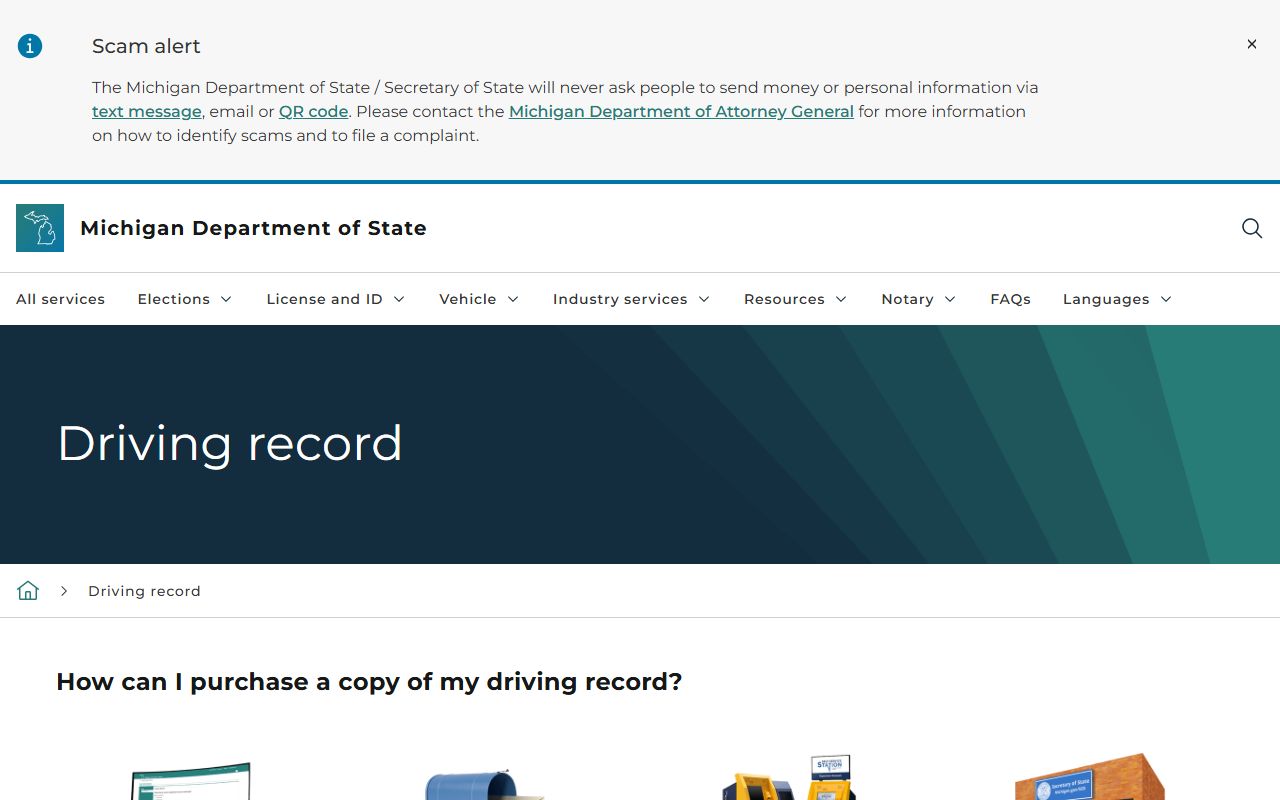
That state file is where points and license actions actually land after a St. Clair County ticket is resolved. The comparison below shows what sits in each record and where to fix an error.
| Court Traffic Record | State Driver Record | |
|---|---|---|
| Record source | 72nd District Court case file. | Michigan Secretary of State. |
| What is in it | Citation, charge, hearings, plea or responsibility, fines and costs, payment status, and disposition. | License status, points, reported convictions and abstracts, and suspensions. |
| Where to access | District Case Records or MiCOURT, or call the court. | Michigan SOS online services or by mail. |
| How to correct errors | Contact the 72nd District Court that holds the case. | Contact the Michigan Secretary of State. |
Requesting a Michigan Driver Record
When points, a suspension, or license status is the real question, the driver record is the file to pull, not the court case. The Michigan Secretary of State sells this record online and by mail. Access can be limited under the federal Driver's Privacy Protection Act, which means a third party may need a permissible purpose before the state releases a record. The Secretary of State spells out these rules in its driver and vehicle records FAQ.
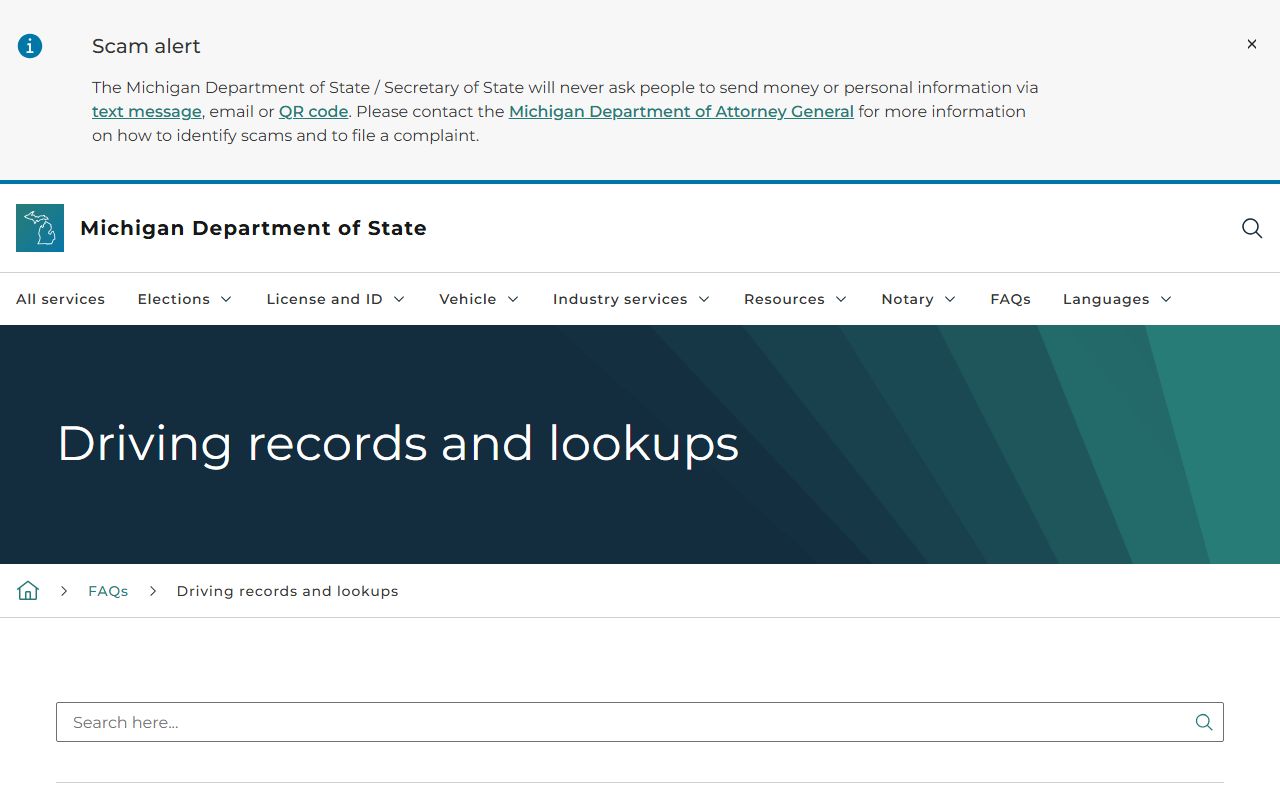
The FAQ lists the Record Sales Unit for questions about buying a record, and it covers the main request channels a driver can use.
- Online services - buy an electronic copy of a driving record through Michigan SOS Online Services.
- Mail request - request and receive a record by mail using the state record request form.
- Permissible use - identity and DPPA permissible purpose may be required for a third-party request.
- Record Sales Unit - email CommercialServices@Michigan.gov with driver and vehicle record questions.
St. Clair County Traffic Record Access Laws
Court files in Michigan follow court rules first, not the general records act. Most traffic case information is open for public inspection unless a statute, a court rule, or an order restricts it. The Michigan Freedom of Information Act still covers many public bodies, and it sets how offices respond to written requests, but judicial records sit under their own access rules.
Key rules and statutes:
MCR 8.119 - governs court records and public inspection in Michigan trial courts unless restricted by statute, rule, or order.
Michigan FOIA, Act 442 of 1976 - gives public access to many public records, though courts apply separate access rules.
MCL 15.235 - sets the timing a public body must follow after a written FOIA request.
CDL and Commercial Driver Records
Commercial drivers face tighter rules on any citation. A ticket that a regular motorist might quietly pay can carry heavier consequences for a commercial driver license holder. Federal reporting means a conviction often reaches the driver record no matter how minor the fine looks. That can affect a job, so a quick online payment is rarely the safe move for a CDL holder.
Because paying admits responsibility, a commercial driver should weigh a hearing before resolving a St. Clair County ticket. Call the 72nd District Court traffic and criminal line to ask about the process. When license status or points are in play, pull the Michigan driver record rather than relying on the court case screen alone.
Note: The court cannot advise a commercial driver on job impact, so a CDL holder facing a serious citation should speak with an attorney before entering any plea.
DUI and Drunk Driving Cases
Drunk driving is not an ordinary traffic ticket. A charge such as operating while intoxicated is a criminal matter, and it moves on the criminal track rather than the civil-infraction path. Early stages start in the 72nd District Court, and serious cases can bind over toward the Circuit Court. The 72nd District Court also runs a Recovery Court program for certain misdemeanor driving offenses tied to severe alcohol problems.
Because these cases carry jail exposure and a formal plea, they generate a full criminal case file, not just a citation record. For how a drunk driving case is charged and resolved, see the St. Clair County criminal court records page. General search tools for every case type live on the St. Clair County court records page.
Sealing St. Clair County Traffic Records
Michigan does not seal records with a generic order. It uses a set-aside process for qualifying convictions under MCL 780.621 and later amendments. A civil infraction is not a conviction, so most plain traffic tickets are not the kind of record this process clears. Criminal traffic convictions can be a different story, depending on the offense and a person's history.
A set-aside is usually filed in the court where the conviction happened. A qualifying St. Clair County misdemeanor normally routes back to the 72nd District Court. The process can require fingerprints, certified conviction records, and notice to the prosecutor and state officials, and eligibility depends on offense type, the number of convictions, and later criminal history. Anyone considering it should confirm eligibility before filing.