
How to Search St. Clair County Court Records
Choose the court before you choose a portal. Felonies, civil claims over $25,000, divorce and family matters, and appeals from the district court belong to the 31st Circuit Court. Traffic tickets, misdemeanors, ordinance cases, landlord-tenant disputes, small claims, and civil claims under $25,000 belong to the 72nd District Court. Estates, trusts, guardianships, conservatorships, and mental-health proceedings belong to the Probate Court. Picking the wrong court sends you to the wrong clerk and the wrong copy path.
The county's Court Schedules and Records page is the official routing hub. It links to Circuit Records and Schedules, District Case Records, Probate Case Records, and the matching schedules. For 31st Circuit Court cases, use the St. Clair County Web Inquiry, the public entry for circuit case records. For district and probate cases, use the state MiCOURT Case Search reached through the county's district and probate links. Circuit cases use the case-number format 99-000000-XX, and you can search by party name to find that number.
Gather a few details first. A full name spelled correctly speeds a name search. A case number returns a single case fast. A year the case opened, a judge name, and a document date all help the clerk locate a file when you order a copy.
- Identify the court level first. Match your case to the circuit, district, or probate court by case type and dollar amount.
- Open the county Court Schedules and Records page rather than guessing at an outside search result. It is the official routing page.
- For circuit cases, use Circuit Records and Schedules through the Web Inquiry. Note the case number, party names, judge, and year opened.
- For district or probate cases, open MiCOURT, select the St. Clair County court, then search by name or case number and confirm the case type and status.
- If the online entry is thin, request the document from the office that keeps that court's file: the County Clerk for circuit, the District Court office for district, the Probate Court for probate.
- For older, sealed, or non-digitized records, call or visit the court office. A missing online result does not mean the case does not exist.
St. Clair County Court Records Search Fields
MiCOURT Case Search is the state tool for district and probate cases where the court takes part. It loads as a public web app and uses a security check before it runs a query. You pick a court, choose whether to search by person, business, or case number, then fill the fields that apply. Not every field shows for every court, and the tool works as a public index rather than a promise that each document image can be downloaded.
| Field Label | Type | Required | Notes / Format |
|---|---|---|---|
| Court / Court selection | Dropdown | Yes | Select the participating Michigan court; St. Clair County district and probate link from the county page. |
| Search type | Tabs | No | Person, business, or case-number search; the tab layout is dynamic. |
| Last Name / Business Name | Text | Conditional | Used for a name search. |
| First Name | Text | No | Narrows a person search. |
| Date of Birth | Date | No | Usually MM/DD/YYYY when shown; use only when known. |
| Case Number | Text | Conditional | Enter the court case number if you have it. |
| Case Status / Case Type | Dropdown | No | Availability varies by court and case category. |
| Date range | Date picker | No | Availability varies by court. |
| Search | Button | n/a | Runs the query. |
| Reset / Clear | Button | n/a | Clears the fields where shown. |
The 31st Circuit Web Inquiry works a little differently. You select the circuit court group, accept a short notice that the online record is informational and does not replace the official file, then search by party name or case number. The Circuit Records and Schedules path shows both case records and hearing schedules in one place.
Types of St. Clair County Court Records
The record type follows the case type, and the case type follows the court. Circuit civil files hold larger lawsuits with complaints, answers, motions, orders, and judgments. District civil files hold smaller disputes, small claims, and landlord-tenant matters, with summons, proof of service, defaults, and satisfactions. Criminal files split by level. Felonies move to the circuit court after the district court handles the early stages, while misdemeanors and ordinance cases stay in the district court.
Family and probate files stand apart. The Family Division of the circuit court handles divorce, paternity, child support, juvenile cases, some guardianships, and name changes. The Probate Court handles wills, decedent estates, trusts, guardianships, conservatorships, and mental-health proceedings, and it does not hear criminal, traffic, or divorce matters.
- Circuit civil: lawsuits over $25,000, with complaints, motions, orders, and judgments.
- District civil: small claims, landlord-tenant, and claims under $25,000.
- Criminal: felonies in the circuit court, misdemeanors and ordinance cases in the district court.
- Traffic: citation case files in the 72nd District Court, separate from the state driver record.
- Family: divorce, paternity, child support, and juvenile files in the Family Division.
- Probate: estates, trusts, guardianships, conservatorships, and mental-health files.
Note: juvenile, adoption, and mental-health files carry extra privacy limits and should not be treated like ordinary public civil records.
What St. Clair County Court Records Show
A court record is more than a name and an outcome. It gathers the parties, the filings, the hearing history, and the money owed into one case file. Michigan publishes the statewide rules for how trial courts build and keep those files through the state courts records management page, which sets what St. Clair County must retain and how long.
Those standards shape the fields you see in a St. Clair County court records search. The table below lists the common fields drawn from the county's request forms and the state case-file rules. Some fields, such as party names and the case number, appear on nearly every file. Others, such as financial entries or hearing details, depend on the case type.
| Field | What It Shows |
|---|---|
| Court Name | The court that owns the file: 31st Circuit Court, 72nd District Court, Probate Court, or Family Division. |
| Case Number | The unique case identifier; circuit cases use the pattern 99-000000-XX. |
| Parties | Party 1 and Party 2 by first and last name, such as plaintiff and defendant or petitioner and respondent. |
| Year Case Opened | The year the case was filed, a field the clerk uses to locate older files. |
| Judge | The assigned judicial officer, listed by name and room in the court directory. |
| Document Description | The specific filing and date, for example a motion filed on a given day. |
| Case Type | Felony, civil, domestic, traffic, misdemeanor, small claims, estate, guardianship, or conservatorship. |
| Docket Events | Hearings scheduled, motions filed, orders entered, judgments, sentencing, payments, and closure. |
| Financial | Fines, costs, restitution, bond, and payment entries; circuit payments follow MCL 780.766a. |
| Restrictions | Juvenile names, Social Security numbers, account details, and medical data may be redacted. |
Ordering St. Clair County Court Records From the Clerk
The St. Clair County Clerk and Register of Deeds, Angie Waters, keeps records of the 31st Circuit Court only. Both the Court Document Request Form and the Divorce Judgment Request Form state in capital letters that the Clerk holds circuit records and that the request does not include district, probate, or any other court. Readers often assume one clerk supplies every file, so this line matters. District Court records route to the 72nd District Court office, and probate files route to the Probate Court.
The online forms ask for party names, the year the case opened, an optional case number in the 99-000000-XX format, an optional judge name, a document description with a date, and your mailing and email details. You can add a certified copy for legal use. Fees are set and paid online. Michigan also sets how fast a public office must answer a written records request under MCL 15.235.
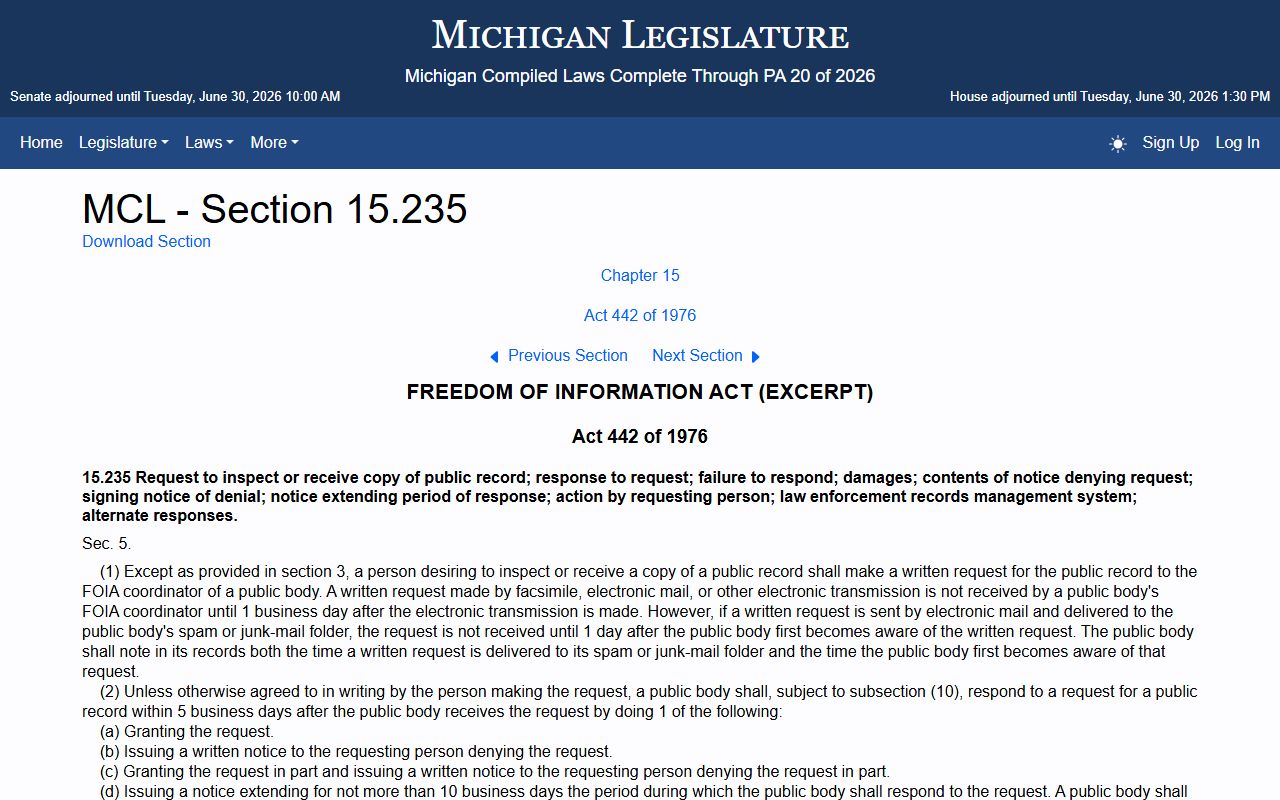
The statute frames the response clock for records held by public bodies, though court files also answer to court rules. The fee schedule below covers the circuit court copy requests the Clerk processes online.
| Item | Fee |
|---|---|
| Emailed PDF of a 31st Circuit Court document | $15.00 |
| Online processing fee (all transactions) | $5.00 |
| Certified copy up to 25 pages by mail plus emailed PDF | Additional $10.00 |
The processing fee is not refunded when the record is not held in St. Clair County, which is another reason to confirm the court level first. Attorneys have a separate electronic fax filing path for circuit pleadings. More detail on the office and its full form set lives on the St. Clair County Clerk page.
Public Access to St. Clair County Court Records
Michigan gives the public broad access to court files, with limits set by rule and statute. The Freedom of Information Act, Act 442 of 1976, starting at MCL 15.231, opens many records of public bodies. Court files, though, answer first to the court rules rather than to ordinary FOIA, because judicial records follow their own access framework.
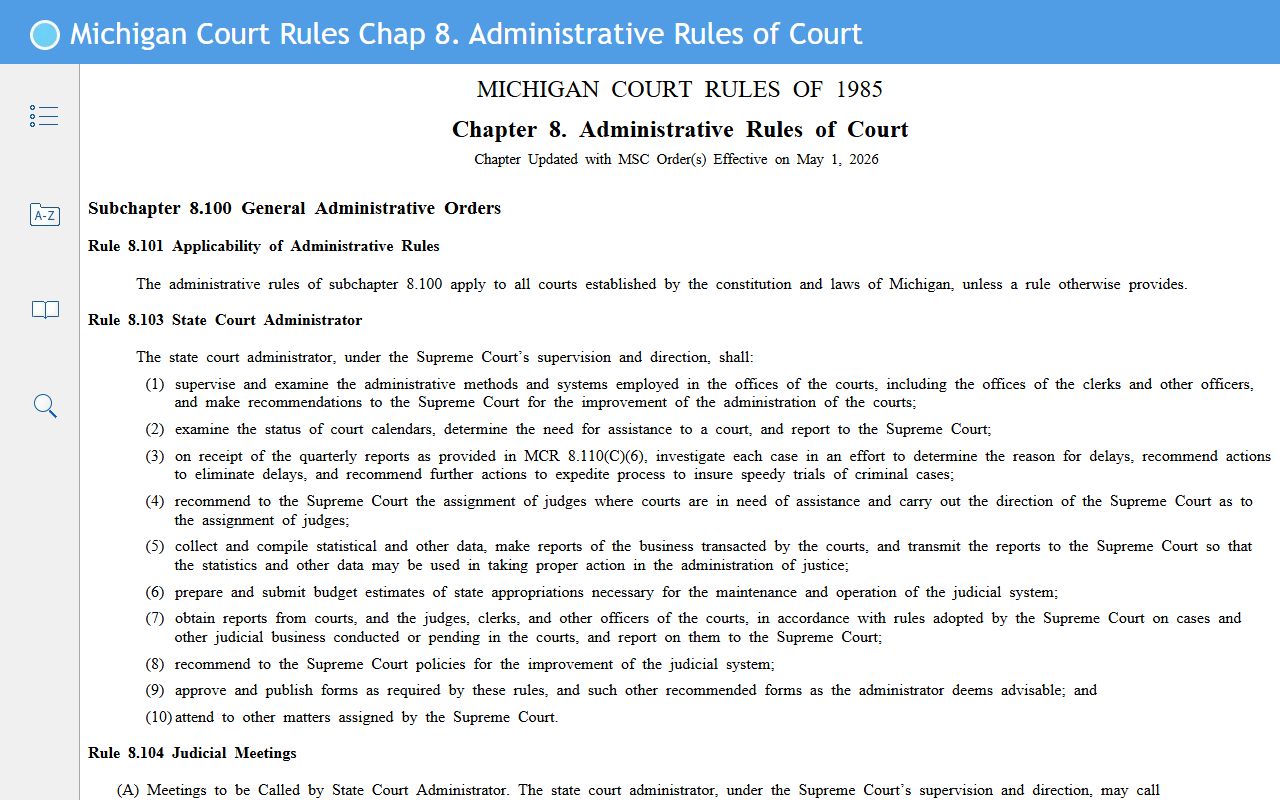
That framework lives in the Michigan Court Rules. The Chapter 8 rules include MCR 8.119, which governs court records and public inspection in the trial courts unless a statute, a rule, or a court order restricts a file. Public inspection is the default, and the courts note that a file can be open at the courthouse even when some fields or documents stay sealed or offline.
In practice, the first access path is the court or office that owns the record. Circuit files go through the County Clerk, district and probate files through MiCOURT and the court offices, and sheriff reports through the Sheriff's Service Bureau records process. The county posts FOIA forms, a cost-itemization form, and an appeal form for requests that fall under the act.
Note: A St. Clair County court file may be open for inspection while certain fields stay redacted, so an online result is not always the complete record.
Sealed and Confidential St. Clair County Court Records
Some files sit outside ordinary public search. Juvenile records from the Family Division are limited to parties, attorneys, agencies, or people the court allows by order. Adoption files are confidential and route through the Family Division and Probate Court. Mental-health proceedings can hold medical and treatment details, so access is narrower than for standard civil filings. Records that are sealed, set aside, or expunged do not show through the public portals and should not be requested as if open.
Michigan clears many qualifying convictions through a set-aside process under MCL 780.621 and the sections that follow. A person starts by identifying the conviction, the court, the date, the offense, and the sentence, then confirms eligibility under state law. The petition is usually filed in the court where the conviction happened, so a St. Clair County misdemeanor normally goes to the 72nd District Court and a qualifying felony to the 31st Circuit Court. Some cases now qualify for an automatic set-aside, while others need fingerprints, certified records, notice to the prosecutor and state, and a hearing. After a set-aside, the conviction leaves ordinary public criminal history, though authorized court and law-enforcement access can remain.
In-Person St. Clair County Court Record Requests
You can also request records at the courthouse in downtown Port Huron. The County Building at 201 McMorran Boulevard holds the circuit, district, and probate courts under one roof, with a different room for each office. Bring a case number or full party names, a photo ID, and payment for any copy fee. Circuit copies come from the County Clerk in Room 1100. District Court records are handled in Room 2900 in Port Huron or at the Marine City branch, and probate files come from the Probate Court in Room 2700.
St. Clair County Clerk / Register of Deeds
201 McMorran Blvd., Room 1100
Port Huron, MI 48060
(810) 985-2200
Monday to Thursday 8:00 a.m. to 4:15 p.m.; Friday 10:00 a.m. to 4:15 p.m.
The circuit, family, and probate offices keep hours of 8:00 a.m. to 4:30 p.m. on weekdays, while district court hours run to 4:30 p.m. with a later Friday start. The genealogy room at the Clerk's office is by appointment only. Call ahead for older or restricted files so the office can pull them before you arrive.